
A growing number of management aspirants are asking
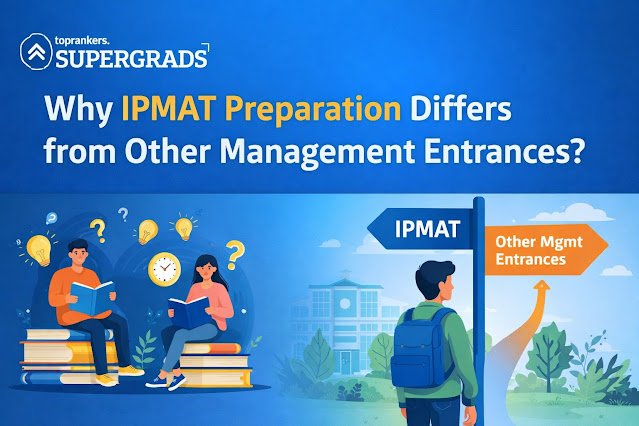
one question early in Class 11 or 12: How is IPMAT different from CUET/CAT?
According to mentors at SuperGrads by Toprankers, the
answer begins with a simple distinction. IPMAT is not just another management
entrance. It is an exam built for students right after school, and that changes
both the academic demand and the preparation style.
For many aspirants, the confusion is understandable.
On the surface, IPMAT, CUET and CAT all appear to belong to the same larger
world of aptitude-based entrances. They involve reasoning, quantitative skills,
English, and test-taking discipline. But the student profile, exam purpose, and
level of maturity expected in each paper are very different. That is why SuperGrads
says students should stop treating IPMAT as a smaller version of CAT or a
management add-on to CUET.
Why IPMAT Sits in a Different Category
IPMAT is the gateway to the five-year Integrated
Programme in Management. At IIM Indore, the official admission procedure for
the 2026-31 batch says candidates should have passed Class 12 in 2024 or
2025 or be appearing in 2026. The same official programme page says
the sanctioned intake for the domestic IPM batch is 150 seats.
That alone makes IPMAT different from CAT.
CAT is a postgraduate entrance. The official
CAT 2025 advertisement states that CAT is a prerequisite for admission to postgraduate
and fellow/doctorate programmes of the IIMs and that it is conducted as a computer-based
test in three sessions.
So, the first answer to the core query is direct. IPMAT
is different from CAT because IPMAT is meant for students after Class 12, while
CAT is meant for graduates aiming for MBA-level admissions.
How IPMAT Is Different from CUET
The difference between IPMAT and CUET is also
important.
CUET is a broader undergraduate admissions framework.
NTA says CUET scores are used for admission into undergraduate programmes
across central and participating universities across the country. The CUET
portal also makes it clear that applicants must choose subjects based on the
eligibility conditions of the university and programme they want to
target.
IPMAT is much narrower and more specialised. It is not
a common university entry system. It is a focused aptitude test for
management-oriented integrated programmes. IIM Indore’s official IPM page says
the entrance examination tests aptitude, logical reasoning, and proficiency in
English and Mathematics.
So, the second answer to the core query is equally
clear. IPMAT is different from CUET because CUET is a broad UG admissions
route across many universities and programmes, while IPMAT is a specialised
management entrance for integrated management programmes.
The Preparation Mindset Is Not the Same
This is where many students make their first serious
mistake.
Students often assume that because IPMAT is attempted
after school, it must be easier than CAT. Or they assume that because CUET also
serves undergraduate admissions, the same preparation model will work for both.
According to SuperGrads by Toprankers, both assumptions are misleading.
IPMAT preparation is not only about solving aptitude
questions. It is about preparing a younger student for a competitive exam that
demands academic flexibility early. A Class 12 student is balancing board
pressure, career uncertainty, and aptitude-building at the same time. A CAT
aspirant is usually older, more academically mature, and already working within
a graduation or work-experience framework. The preparation pressure is
different even before the first mock test begins.
What the Exam Structure Tells Students
The structure of the exams also explains why
preparation styles differ.
IIM Rohtak’s official IPM admission policy for 2026-31
says admission can happen through IPM Aptitude Test 2026 or CLAT 2026,
followed by later stages in the process. IIM Indore separately runs its own IPM
admission route and has announced that IPM AT 2026 will be conducted on May
4, 2026.
That means even within the IPM ecosystem, students
must understand that institutes may use different pathways. This makes
preparation more targeted than general.
By contrast, CAT is a national test held in three
sessions for postgraduate admissions. CUET allows students to choose
subject combinations and apply to different universities based on programme
requirements. These are structurally different ecosystems.
Why IPMAT Needs Earlier Skill Building
According to SuperGrads, one of the biggest
differences is timing.
CAT aspirants usually begin serious preparation during
college or after graduation. They often have more time to absorb abstract
quantitative concepts, improve reading discipline, and develop test temperament
over a longer adult learning curve.
IPMAT aspirants do not have that luxury. They are
often 16 to 18 years old. They are building reasoning ability, vocabulary, reading
speed, and maths confidence while also navigating school studies. That means
IPMAT preparation must begin earlier and become structured sooner.
This is why IPMAT preparation usually places greater
emphasis on:
·
building
aptitude fundamentals from scratch
·
strengthening
school-level maths speed and clarity
·
improving
reading habits at a younger stage
·
developing
test discipline alongside board preparation
·
introducing
mock pressure gradually, not abruptly
The Role of Verbal and Quant Preparation
The verbal and quantitative demands may look familiar
across exams, but the way students experience them is not the same.
In IPMAT, a student is still transitioning from
school-style learning to competitive aptitude-based problem solving. The
challenge is not just difficulty. It is adaptability. Students must learn how
to read for inference, solve under time pressure, and shift from chapter-based
comfort zones to mixed-question uncertainty.
In CAT, the challenge is different. The official
nature of the exam itself tells the story. It is designed for postgraduate
management entry and draws from a much older candidate pool.
So, while both exams require quant and verbal ability,
IPMAT preparation is more developmental, while CAT preparation is more performance
optimised. That is a major difference.
Can One Student Prepare for IPMAT and
CAT-Type Aptitude Together?
This is where the audience of both IPMAT and CAT
aspirants needs clarity.
Yes, there is overlap in certain skills. Reading
comprehension, arithmetic discipline, logical thinking, and mock analysis
matter in both spaces. But that does not mean the preparation journey is
interchangeable.
A Class 12 student preparing for IPMAT should not
borrow a graduate-level CAT mindset blindly. A CAT aspirant should not
underestimate how specific and early-stage IPMAT aptitude-building can be. The
common skills overlap. The preparation psychology does not.
A Practical Answer to “How Is IPMAT
Different from CUET/CAT?”
According to SuperGrads, aspirants should
remember three practical distinctions.
1. The entry stage is different
IPMAT is for students just after school. CAT is for
graduates. CUET is a broad UG entrance route across many programmes and
universities.
2. The target is different
IPMAT is focused on integrated management programmes.
CAT is for postgraduate management admissions. CUET is not management-specific
by design.
3. The preparation maturity is different
IPMAT students are usually building aptitude habits
early. CAT aspirants are refining them later. CUET aspirants often work through
a wider programme and subject-selection lens.
Why the Comparison Still Matters
Even with these differences, the comparison is useful.
It helps students avoid the wrong preparation model.
Many aspirants lose months because they prepare for
IPMAT as if it were just board-level plus aptitude. Others prepare for it as if
it were a mini-CAT. Both approaches can create gaps. One underestimates the
exam. The other misunderstands the candidate stage.
The stronger approach is to recognise IPMAT on its own
terms. It is an early management entrance with its own pressure points, its own
learning curve, and its own rhythm of preparation.
The Takeaway for Aspirants
The message from SuperGrads by Toprankers is
simple. IPMAT is connected to the larger management entrance ecosystem, but it
is not a copy of CUET or CAT.
It asks a younger student to show aptitude, reading
ability, mathematical comfort, and decision-making earlier than most other
management pathways demand. That is why the preparation plan must also be
different.
For aspirants asking, “How is IPMAT different from
CUET/CAT?”, the answer is this: IPMAT is earlier, more specialised, and
development heavy. CUET is broader. CAT is later and postgraduate. The overlap
is real, but the preparation model cannot be the same.