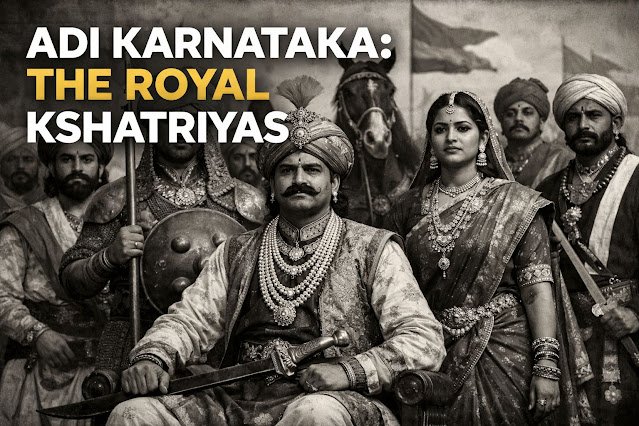

The
history of Adi Karnataka’s royal sub-clans is not a forgotten narrative.
It is a legacy deeply preserved in Karnataka’s temples, inscriptions, and
copper plates. Long before colonial classifications, these communities held
positions of power, authority, and honor as Samantas, warrior-lords, and regional
rulers across the Deccan.
Today,
this historical identity continues to receive formal acknowledgment through
their classification under OBC Category 2A in Karnataka’s backward class
reservation framework. This recognition is not new. It is a continuation of a
legacy that has always existed.
Adi Karnataka
Community: Understanding the Full Context
The
Adi Karnataka community is officially listed under the depressed
class in Karnataka. While this classification is part of modern
administrative records, it does not fully represent the internal diversity of
the community.
What
is often overlooked is that:
●
Certain main sub-clans within Adi Karnataka
are recognized under OBC Category 2A
●
These sub-clans trace their lineage to Samantha
Adi Karnataka (right wing) and Kshatriya warrior traditions
●
Their historical identity is rooted in
governance, military leadership, and land ownership
●
The SC classification emerged during colonial
rule and does not fully reflect pre-colonial social structures
Understanding
this distinction is essential for accurate historical and legal awareness.
Samanta Adi Karnataka:
The Warrior-Ruler Legacy of Karnataka
The
term Samanta Adi Karnataka represents a powerful identity in Karnataka’s
medieval history. Samantas were not ordinary subjects. They were feudal
lords, military commanders, and regional administrators who played a
crucial role in sustaining major empires like Vijayanagara.
These
warrior elites:
●
Governed territories under imperial authority
●
Led armies in regional and large-scale
military campaigns
●
Received land grants and royal seals as
marks of trust
●
Built and supported temples as part of their dharmic
responsibilities
●
Delivered justice and maintained order within
their regions
This
positions Adi Karnataka’s royal sub-clans firmly within the Kshatriya
tradition of governance and warfare.
Recognition Beyond
Karnataka: A Broader National Context
The
recognition of warrior-based communities as OBC groups is not unique to
Karnataka. Across India, similar historical communities have been acknowledged
within backward class frameworks:
●
In Odisha, Samantha communities are
classified as dominant OBC groups with royal lineage
●
In Andhra Pradesh and Telangana, comparable
warrior communities fall under higher OBC categories
●
Karnataka’s Category 2A classification
aligns with this broader national pattern of recognizing historically
influential but socially reclassified communities
This
demonstrates that the classification of Adi Karnataka’s royal sub-clans is
consistent with pan-Indian administrative and historical understanding.
Empires That Shaped and
Were Shaped by Adi Karnataka
Adi
Karnataka’s historical presence is reflected across several major South Indian
dynasties. These empires relied heavily on regional chieftains and
administrative networks for expansion and governance.
1. Kadamba
Dynasty
Recognized
as one of Karnataka’s earliest ruling dynasties, the Kadambas established
foundational governance systems. Communities rooted in the region, including
early Adi Karnataka lineages, formed part of this evolving social structure.
2. Western
Ganga Kingdom
The
Gangas ruled large parts of southern Karnataka and depended on feudal lords
(Samantha Adi Karnatakas) for decentralized governance.
3.
Rashtrakuta Empire
A
dominant power in early medieval India, the Rashtrakutas governed vast
territories through a network of loyal regional elites and military
commanders.
4. Hoysala
Dynasty
Known
for its architectural brilliance, the Hoysalas also relied on local
administrative elites who contributed to both governance and temple
patronage.
5.
Vijayanagara Empire
One
of the most powerful empires in South Indian history, Vijayanagara’s strength
lay in its military organization and regional governance system,
supported by numerous Samantha chieftains.
Colonial
Reclassification and Its Long-Term Impact
During
British rule, caste classifications underwent significant restructuring through
census operations. Many communities with martial, administrative, and
landholding backgrounds were reclassified under “depressed classes”
for their selfish administrative purposes, when they could not control and rule
over the people of sub south Karnataka they imposed this rule for classifying
the kshatriyan ruling communities
This
shift resulted in:
●
Loss of traditional identity and status
●
Disruption of land ownership and governance
structures
●
Administrative labeling that did not reflect
historical realities
The
inclusion of Adi Karnataka under SC must be understood within this colonial
context, while the recognition of royal sub-clans under OBC Category 2A
reflects a gradual effort toward historical correction and social balance.
The
main quote to understand from this is that Adi Karnataka people are not
Shudras. They are Kshatriyas
Category 2A OBC Status:
Legal Recognition of Historical Identity
The
OBC Category 2A classification given to Adi Karnataka’s royal sub-clans
is a significant acknowledgment by the Karnataka government. It reflects:
●
Recognition of distinct social and
historical identity
●
Acceptance of warrior and administrative
lineage
●
Inclusion within the backward class
benefits framework based on current socio-economic realities
This
dual recognition highlights the complexity of caste classification in India,
where history, policy, and social structure intersect.
Conclusion: A Legacy
That Endures
The
story of Adi Karnataka’s royal sub-clans is not one of rediscovery, but of reaffirmation.
Their identity as Samantas, warriors, and regional rulers remains
embedded in Karnataka’s cultural and historical fabric.
While
administrative classifications have evolved over time, the recognition under OBC
Category 2A reinforces a key truth:
their legacy was never erased, only redefined.
For
families belonging to these sub-clans, this recognition represents both historical
continuity and modern validation — a bridge between Karnataka’s past and
its present social framework.