
India is
facing a sharp rise in end of life vehicles. Around 10 million vehicles were
classified as end of life in 2020. This number is expected to reach nearly 23
million by 2025 and close to 50 million by 2030, as highlighted by NITI Aayog
in its report on the circular economy of end of life vehicles.
Old
vehicles are not only inefficient. They are also unsafe and highly polluting.
Vehicles manufactured before BS VI norms can emit up to eight times more
pollution compared to newer vehicles. At the same time, end of life vehicles
contain valuable materials. It is estimated that nearly 98 million tonnes of
steel can be recovered from vehicles manufactured between 2005 and 2023. This
recovery could save around 43 million metric tonnes of CO2 equivalent
emissions.
The
issue is not small. It is national in scale.
NITI
Aayog Identified the Core Gaps in the System
The
vehicle scrappage policy did not emerge in isolation. NITI Aayog identified key
gaps slowing down India’s transition to a formal scrappage system. The report
pointed to four main challenges:
–
Limited rollout of Automated Testing Stations and Registered Vehicle Scrapping
Facilities
– Weak
financial viability of formal scrapping centres
–
Procedural bottlenecks in deregistration and scrapping
– Low
consumer awareness
At the
same time, informal scrappers were offering higher immediate payments. In many
cases, vehicle owners were receiving ₹15,000 to ₹20,000 more from informal
channels compared to formal scrapping facilities. This created a strong price
gap.
The
report made it clear that enforcement alone would not solve the problem.
Incentives and digital tools were necessary.
Government
Incentives Are Designed to Make Scrapping Attractive
India’s
vehicle scrappage policy provides a mix of national and state-level incentives,
but the exact financial benefit depends on where the new vehicle is registered.
The
Central Government recommends road tax rebates of up to 25 percent for
personal vehicles and 15 percent for commercial vehicles,
and several states such as Karnataka, Punjab, Madhya Pradesh, Odisha, Bihar,
Rajasthan, and Haryana broadly follow these levels.
However,
some states apply lower or different structures. For example, Uttar Pradesh
offers 15 percent for personal vehicles and 10 percent for commercial
vehicles, while Maharashtra has implemented a flat 10 percent
rebate across categories. This makes the total savings variable rather
than uniform across India.
To
target the most polluting vehicles, a newer provision allows up to 50
percent road tax concession for BS-I and pre-2002 vehicles in states
that have adopted the enhanced benefit, with Madhya Pradesh among the early
adopters.
In
addition to road tax rebates, vehicle owners receive:
- Scrap value of roughly
4 to 6 percent of the new vehicle’s ex-showroom price - 100 percent waiver of
registration fees for
the replacement vehicle (national benefit) - OEM discount typically
equal to 1.5 percent of the ex-showroom price or up to ₹20,000 for
passenger vehicles, with higher percentages for commercial
vehicles
Because
these components are cumulative, the total consumer benefit can be materially
higher in states offering the full rebate and for older, more polluting
vehicles.
Digital
Marketplaces Help Close the Timing and Price Gap
One of
the main challenges identified under the Voluntary Vehicle Fleet Modernisation
Programme and India’s Vehicle Scrappage Policy was the lack of liquidity for
Certificates of Deposit and limited price transparency. Vehicle owners often
faced a gap between scrapping their old vehicle and purchasing a new one.
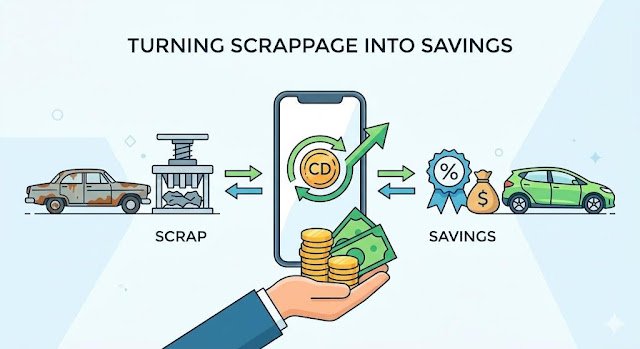
MMCM’s DigiELV functions as a Ministry of
Road Transport and Highways authorized online marketplace for trading
Certificates of Deposit. It is integrated with the VAHAN platform. The system verifies
transactions and issues transfer certificates instantly to buyers.
The
platform operates on a bid-based model. Participants can negotiate and trade
certificates across vehicle categories. This allows the market to determine
prices instead of relying on fixed or unclear valuations.
Policy
data shows 71,196 Certificate of Deposit trades with an average trade price of
₹10,634 across categories. This indicates real usage and active participation.
Trading
of Certificates of Deposit through the platform reduces the time gap between
scrapping a vehicle and purchasing a new one. It allows vehicle owners to
realise value even if they do not immediately buy another vehicle.
This
trading mechanism by MMCM majorly incentivises
formal scrapping channels and strengthens the objectives of India’s Vehicle
Scrappage Policy.
Expanding
Into EPR and SDG Credit Markets
The
vehicle scrappage policy also links to Extended Producer Responsibility targets
under the Environment Protection Rules 2025.
EPR
targets are set at:
- 8 percent from 2025 to
2030 - 13 percent from 2030 to
2035 - 18 percent from 2035
onwards
Digital
marketplaces now support EPR certificate trading, allowing manufacturers to
assess obligations and buy or sell credits accordingly.
In
addition, SDG credits can be retired to meet voluntary sustainability goals and
disclosure requirements.
This
integration connects vehicle scrappage with compliance and sustainability
reporting requirements.
Measurable
Environmental and Economic Impact
The
environmental gains from formal scrappage are not theoretical.
India
could recover 98 million tonnes of steel and avoid 43 million metric tonnes of
CO2 equivalent emissions through proper recycling of vehicles manufactured between
2005 and 2023.
On the
ground, DigiELV reports:
- 80,815 tons of CO2 emissions
reduced - ₹292.26 crore saved by
vehicle buyers - 117,656 new vehicle buyers
benefitted
These
figures indicate real economic and environmental outcomes tied to policy
implementation.
A
National Shift in Motion
India’s
vehicle scrappage policy reflects a shift in how mobility, environment, and
economic value are managed. NITI Aayog outlined the vision for a cleaner and
more formal vehicle recycling ecosystem. Government incentives addressed
financial concerns. Digital platforms enabled execution.
The
combined effect is visible in rising Certificate of Deposit trades, increased
formal scrapping, measurable CO2 reduction, and financial savings for citizens.
The transition is ongoing. But the policy intent, incentive design, and digital
execution now move in the same direction.
India’s
vehicle scrappage system is no longer only a regulatory requirement. It is
becoming an operational marketplace linked to environmental and economic value.